

Skip to content
Sign up free

For individual-sport athletes

The journal you keep on every opponent — and on yourself.

You've faced her twice. What did you learn? OpponentBook is a private book of everyone you compete against — what worked, what didn't, what to remember next time. On your own cloud storage, in your own words.

  • Free forever — the whole journal
  • Your notes live on your storage, not our servers
  • No streaks. No badges. No noise.
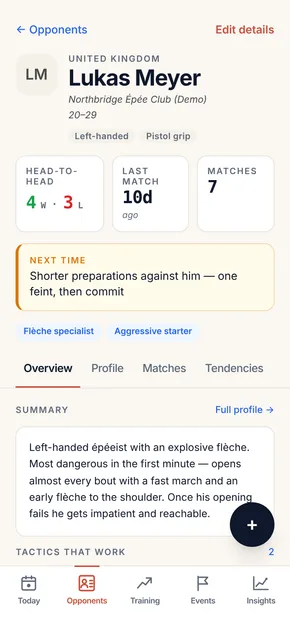
An opponent profile in OpponentBook: head-to-head record, style tags, and the note to reread next time.

What makes it different

Somewhere to think between matches.

Your storage

01

We cannot read your notes.

Everything you write lives on your own Google Drive, Dropbox or iCloud — never on our servers. Not "we promise we won't look." There is nothing on our side to look at.

No streaks

02

Quiet by design.

No badges, no guilt, no push notifications begging you to come back. You write when there's something worth writing. The app's job is to remember it — and quietly surface patterns.

Your sport

03

Drawn for your playing surface.

Drop pins on a real schematic of the piste, table, court, mat or ring. Sixteen sports, each with its own diagram or position layout, fields and vocabulary — not a generic notes app with sport skins.

The book

Everything a scouting book should hold. Free, forever.

The whole journal is the free tier — not a teaser. Unlimited opponents, matches, media and sync. Paid tiers add intelligence on top; they never ration the notebook.

01

Opponents

A living profile for everyone you face — structured fields, free-form observations, full match history.

02

Matches

Score, score by period, and the three questions that matter — what worked, what didn't, what to remember.

03

Pins on the surface

Tap the schematic where it happened — worked, didn't, danger, tendency. Watch patterns accumulate.

04

Photos & video

Unlimited, because it's stored on your cloud. Clip the exchange you never want to forget.

05

Events

Tournaments as first-class things — prep the field before, review the day after.

06

Training journal

Sessions, focus, effort. Your training log lives next to your opponent book, where it belongs.

07

Exports for your coach

One opponent, a full scouting brief, or the whole book — to PDF or Word, free at every scope.

08

Offline & synced

Works at the venue with no signal. Syncs across phone, tablet and laptop through your own storage.

The signature feature

Where does she score on you?

During or after a match, drop a pin on the schematic — the actual piste, table, court or mat. Each pin takes a short note. With Premium, months of pins aggregate into heatmaps — where left-handers score on you, where your own attacks land, where the danger zones are.

  • Four pin kinds — worked, didn't work, danger, tendency
  • Accurate schematics for all sixteen sports — position layouts for the grappling ones
  • Heatmaps per opponent and across your whole book — with Premium
The annotation screen: a fencing piste schematic with four pins, each grouped by kind with its short note.
An opponent's annotation heatmap: piste zones shaded by where actions worked, failed or turned dangerous, with an action-success list below.

Screen by screen

What keeping the book actually looks like.

Real screens from the app — the same journal on phone, tablet and laptop. Everything here is on the Free tier unless the card says otherwise.

01

A living profile for everyone you face

Not a contact card — a scouting record. Each profile keeps your head-to-head, structured fields where structure helps (handedness, grip, style tags), free text where it doesn't, and the one line you'll want just before you meet again — what to do next time.

  • Search and filter the whole book by name, club or style tag
  • Tendencies accumulate with evidence — "stalls before flick · 3 of 5 bouts"
  • The Next time note sits at the top, readable in the call area in five seconds
The opponents list: six profiles with club, head-to-head record and style tags, filterable by tag.
02

Log a match in three lines

Score first, then the three questions that matter — what worked, what didn't, what to remember. Thirty seconds while it's fresh beats a perfect intention to write more later — and every line rolls up to the opponent's profile, where it's useful.

  • Sport-aware scoring — by period, sets or rounds, sudden death and golden score included
  • Pins and reflections live on the match and aggregate on the opponent
  • Photos and video attach without limits — they're stored on your storage
A match detail screen: a win at 10–10 decided in sudden death, with pinned moments on the piste and the three reflection lines — what worked, what didn't, next time.
03

Competitions as first-class things

Create the event, enter who you expect to face, and the book turns it into preparation — it tracks which of them you've reviewed, gives you somewhere to log matches on the day, and keeps the results attached to the event afterwards.

  • Review states per expected opponent — read and unread at a glance
  • Training camps are events too, without the competition scaffolding
  • Past events keep the day's matches together, so seasons stay legible
The events list: the next competition with its date, venue and how many known opponents are entered, then past events including a training camp.
04

Training lives next to the book

Sessions with category, duration, effort and notes — because how you trained explains how you competed. The journal itself is free and unlimited, one tab away from your opponents, where it belongs.

  • A session takes seconds — categories, minutes, an effort score, a line of notes
  • Tags tie sessions to what you're preparing for — an opponent, a competition
  • Weeks roll up quietly — sessions and hours, no streaks to protect
The free training journal: logged sessions grouped by week, with categories, duration, effort scores, tags and notes.
05Premium

A coach's plan, compared honestly

Premium adds training plans — a weekly schedule laid against what you actually logged. The comparison is descriptive, not disciplinary — it reads your journal, it doesn't judge it. And a plan is a file, not a walled garden — share it, or put it straight into your calendar.

  • Plan vs. journal: sessions logged out of sessions planned, and the percentage — stated, not scolded
  • Share the plan as a file — a coach writes one, the whole squad imports it
  • One tap exports the schedule to your calendar (.ics)
A Premium training plan for a six-week base block: the weekly schedule and an honest plan-vs-journal comparison.
A training plan's actions: edit, share the plan as a file, and add the schedule to your calendar as .ics.
06Premium

Analytics about you, for you

Premium turns your own records into the picture a coach would sketch — results by opponent style, monthly win rate, action success rates, and the aggregate heatmap of where things happen across every match you've logged. No one else's data, no benchmarks against strangers.

  • Results by style tag show which archetypes cost you matches
  • Action success can be split by opponent style — what works against whom
  • Every number is computed from your journal, on your device
Insights at Premium: the aggregate spatial heatmap across all logged matches, with zone legend.
Insights at Premium: results by opponent style tag and a monthly win-rate trend chart.
Action success at Premium: success rate per action, compared against one opponent style to show what works against whom.
Sudden-death statistics: win rate across all sudden-death bouts, split by who held priority.
Training analytics at Premium: the last 30 days broken down by category, with weekly volume.
07

Take the book to your coach

Your notes do more when your coach can read them too. Export one opponent, a stretch of the training journal, or the whole book to PDF or Word, free at every scope. Each export is formatted for what it holds — an opponent becomes a scouting brief, your sessions a clean training report.

  • Pick the scope — one opponent, many, training by date range, or everything
  • On Premium, the training report includes the plan-vs-journal comparison
  • PDF for reading, Word for coaches who annotate
The export screen: choose opponents, a training selection or everything, then generate a PDF or Word file.

Android, web, every screen

One journal, on every screen.

OpponentBook is an Android app on Google Play and a web app in any browser — same journal, same screens. Connect your own cloud storage — Google Drive or Dropbox on any device, iCloud in the browser — and every device reads and writes the same book. Log a match at the venue, reread it on the big screen at home.

  • Log on your phone between matches; type up the longer notes at a keyboard
  • Sync travels through your own storage — your notes never route through our servers
  • Offline first — no signal at the sports hall changes nothing, and everything catches up later
Get it on Google Play

On iPhone and iPad, the web app works in Safari for now — a native app is in the works.

app.opponentbook.com
The Today dashboard open in the browser on a laptop: the next competition with a countdown, prep tasks per known opponent, and the week's training.

The honest feature

Does reviewing your notes actually help you win?

OpponentBook quietly notes when you've read up on an opponent before facing them — never what you wrote, just that you prepared. Then it shows you the one number most sports apps would never dare to — your record when you prepared, next to your record when you didn't.

No streaks to maintain, no score to gamify. Just an honest answer to whether the habit is working — because if it isn't, you deserve to know.

71%

when you reviewed first

48%

when you didn't

Illustration — your own numbers build over a season. Free on every plan, stored on your storage, off by a single switch, erasable any time.

Structural privacy

"We don't read your data" is a policy. "We can't" is architecture.

OpponentBook stores your journal on storage you already own — Google Drive, Dropbox or iCloud. Our servers hold your login, your subscription state and AI-usage counters, and an anonymous skeleton of IDs, dates and sport tags. That's the whole list.

What we cannot see

  • Your observations about opponents
  • Match reflections and scores
  • Training entries
  • Photos, video
  • Whether you reviewed before a match

What we do see

  • Your email and login method
  • Your subscription tier
  • Anonymous IDs, dates and sport tags, so your lists load fast

Want your storage provider out of the loop too? Optional end-to-end encryption seals your notes before they leave your device.

How the architecture works →

Sixteen sports at launch

Drawn for every duel.

Sixteen sports, and none of them treated as a skin on a notes app. Every sport gets its own schematic or position layout, structured fields and tag vocabulary — the piste, the table, the court, the mat, the ring.

Fencing

Foil · épée · sabre

Table tennis

Singles or doubles

Badminton

Singles court

Tennis

Singles court

Padel

Doubles · walled court

Squash

Singles court

Judo

Tachi-waza + ne-waza

BJJ

Position-driven

Wrestling

Folkstyle · freestyle · Greco-Roman

Kendo

Shiai-jō · sanbon-shōbu

Boxing

Ring · 3–12 rounds

MMA

Cage · standing + ground

Taekwondo

WT & ITF sparring

Karate

Shōbu ippon · WKF kumite

Kyokushin Karate

Knockdown karate

Ju-jitsu

JJIF fighting system

Multi-sport athletes: switch sports freely, keep separate books, on every tier — including Free.

When you want more than memory

AI that reads your book — only when you ask.

Paid tiers turn your accumulated notes into opponent summaries, pre-competition briefs and pattern analysis. Every AI feature runs on an explicit tap; nothing scans in the background, and a user who never presses the button never sends a byte to AI.

Premium

One-tap opponent summaries

Your five matches of scattered notes on an opponent, distilled to 120 words you can read in the call area.

Pro

Pre-competition briefs

Facing three known opponents on Saturday? Get one phone-ready event brief that covers each of them, built from your own history.

Pro

Patterns across your book

Style archetypes among your opponents, your recurring weaknesses, and how your game has shifted over the seasons — for you, specifically.

What the output actually looks like.

Saved results from real screens — every claim cites the journal entry it came from, and anything thin gets refused rather than invented.

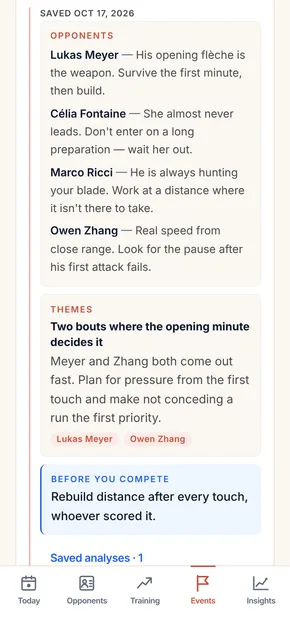
A saved AI competition brief on an event: one tactical line per expected opponent, a shared theme, and a reminder before you compete.
Competition briefPro
A saved AI matchup-pattern analysis for one opponent: a summary, then a success pattern citing the journal entry it comes from and the tactical adjustment it suggests.
Matchup patternsPro
A saved AI playing-style classification: named groups of opponents who play alike, each with how that style plays, your W–L record and win rate against the group, the opponents in it, and a tactical adjustment.
Playing-style classificationPro
A saved AI match review: what decided this match, the pattern it confirms from earlier bouts with cited evidence, and numbered adjustments.
Match reviewPro
A saved AI evolution analysis: a summary, then a pattern marked improving, with the journal evidence behind it and a concrete next step.
Season evolutionPro
A saved AI training-theme summary: recurring themes across recent sessions, each quoting the journal entry it comes from.
Training themesPro
Compare all tiers →

Every AI result you keep is saved to your storage. It's yours forever — even if you cancel.

Your next opponent is someone you've probably faced before.

Start the book now — the first entry takes thirty seconds. Name, club, one observation.

Free forever · No card required · Works offline